Keeping your voice when AI writes your captions
Voice is a short list of habits a reader picks up in about four seconds, and every one of them can be counted, written down and handed to a model.
In this piece
- 01 What a reader actually notices about your writing
- 02 The tells of a caption a machine wrote
- 03 The same post, written two ways
- 04 Read your last twenty captions with a pen
- 05 Handing that page to a model
- 06 Some posts should never go near a model
- 07 Where we come in, and where we do not
- 08 Questions people ask about this
The captions started taking ten minutes instead of forty, and something went slightly flat. Fewer saves. Fewer of those comments where somebody quotes a line back at you. Nothing broke loudly enough to point at, which is the frustrating part, because a problem you cannot name is a problem you cannot fix.
The usual explanation is that the writing lost your voice, and the usual advice is to put it back, which helps nobody. Voice sounds like a quality of the soul. In practice it is a set of habits, and habits can be counted, which means what follows is arithmetic and a forty minute exercise rather than advice about authenticity.
What a reader actually notices about your writing
Nobody scrolling past your post thinks about voice. They register a handful of surface things in the first second and a half, decide whether this sounds like a person they follow, and either read the second line or keep moving. Those surface things are boringly specific.
| The habit | What a reader registers | How to measure it |
|---|---|---|
| Sentence length | Whether reading you feels quick or careful | Count the words in the first sentence of ten captions. Take the middle number |
| Your opening move | Whether this sounds like you or like an advert | Write out the first six words of twenty captions in a single column |
| Questions | Whether you are talking to them or performing at them | Count how many of the twenty end in a question mark |
| Emoji | Your general temperature, before a word is read | Count them, then list the ones that actually recur. Most people use four |
| Person | Whether this reads as advice or as somebody's week | Count every "you" against every "I" |
| What you never do | Nothing, until it appears, and then it is jarring | The words you have been avoiding on purpose. You already know them |
None of this needs a tool. It needs twenty captions in one document and about forty minutes.
The last row is the one people skip and the one that does the most work. A caption that is 90% yours and contains one word you would never say reads as borrowed, and the reader cannot say why either. They just feel handled.
The tells of a caption a machine wrote
Cold prompts produce a recognisable object. Once you can see these five, you cannot unsee them, and you will start noticing them under other people's posts too.
- The list of three. Three tips, three reasons, three things nobody tells you. All roughly the same length, all pitched at the same level of insight. Real advice is lumpy: one big point and a small one you nearly forgot.
- The opening question aimed at nobody. "Struggling to keep your kitchen tidy?" No human opens a caption that way. It is the voice of a leaflet pushed under a door.
- The summary at the end. A closing line that restates the caption you just read, as though a caption needed a conclusion. Look for sentences beginning "at the end of the day" or containing the words "big difference".
- Vocabulary nobody uses out loud. Delve, underscore, showcase, elevate, seamless, robust. Kobak and colleagues, writing in Science Advances in 2025, tracked exactly this class of word appearing at abnormal rates in scientific abstracts after 2022.
- One brightness setting. Every sentence equally enthusiastic. People vary: they get excited about one thing in a post and are flat about the rest, and the flatness is what makes the excitement legible.
That last figure is the one worth sitting with. Russell, Karpinska and Iyyer asked people who use these models constantly to sort three hundred articles by eye, with no training and no detector software, and a majority vote among five of them got 299 right. Your regular readers are that population. They are calibrated on machine writing without having decided to be.
A second effect sits underneath the surface tells. Doshi and Hauser, in Science Advances in 2024, had people write short stories with and without ideas from a language model. The assisted stories were rated more creative and were measurably more similar to one another. Your caption improves and converges with everybody else's at the same time, and the converging half is invisible from inside your own feed.
The same post, written two ways
Maya runs a lifestyle account in Mumbai as @maya.everyday. She has a reel about organising a very small kitchen. Here is the caption a cold prompt gives her, and here is the one that sounds like the person in the video.
What a cold prompt returns
Transforming a small kitchen doesn't have to be overwhelming! ✨ Here are my top 3 tips for making the most of every inch: 1. Declutter ruthlessly 2. Go vertical with storage 3. Keep those countertops clear. Small changes really do make a big difference. What's your best small space hack? Drop it below! 👇
The same post in her own voice
My kitchen is four feet of counter and I am not getting more. Everything lives on one shelf now. Jars, not packets, so I can see what I have without opening anything. It looks boring. It is boring on purpose, and I have stopped buying the same dal twice. One weekend, most of it spent labelling.
| The habit | Cold version | Her version |
|---|---|---|
| Opening move | A reassurance about small kitchens in general | A measurement: four feet, and no more coming |
| Sentence length | Long, with a clause hanging off the end of each | Short. Six of them, and the shortest is four words |
| The ask | A question fishing for comments | None. She lets the post end |
| Emoji | Two, both doing decoration | None, which is her actual habit |
| Detail only she could write | Nothing. This caption fits any kitchen anywhere | The same dal twice. The weekend spent labelling |
| The ending | A summary of what you just read | The unglamorous bit that cost her the weekend |
The second version is worse writing by several measures. It repeats a word, it ends on an afterthought, and one sentence is a fragment. It performs better because somebody who watched the reel recognises the voice in it, and because "I have stopped buying the same dal twice" happened to an actual person. Nobody saves the first caption. Somebody sends the second one to their flatmate.
Read your last twenty captions with a pen
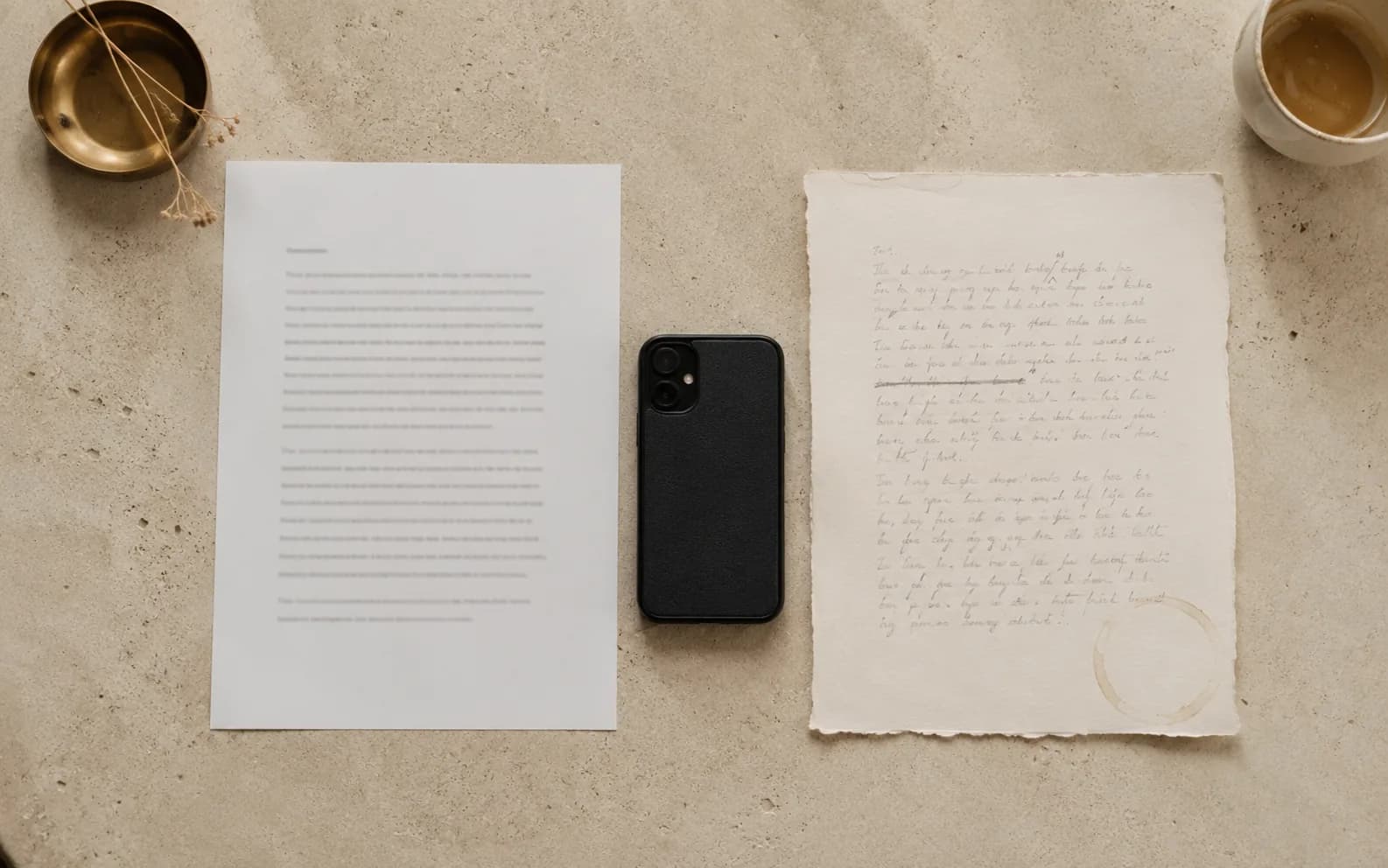
This is the exercise. It takes about forty minutes, it is done once, and the output is a page you will use for a year. Do it by hand, on your own posts, before you consider any software including ours.
- Get twenty captions into one document. Oldest first. Include the ones that flopped, because a habit that only appears in your good posts is not a habit, it is a fluke. Strip the hashtags out into a separate block at the bottom.
- Count the first sentence of each. Words, not characters. Write the twenty numbers in a row and circle the middle one. That number is your opening length, and it is usually far shorter than people guess.
- Copy the first six words of each into a column. This is the step that surprises people. Twenty openings stacked vertically show a pattern that twenty separate posts hide completely. You will find you have two openings and you use them alternately.
- Count the punctuation you actually use. Question marks, exclamation marks, line breaks, ellipses. Then count emoji and list the ones that appear more than twice. Four is the usual answer, and people are always sure it is more.
- Underline every phrase you would say out loud. Not the good lines: the ones that sound like your mouth. Maya's are things like "keep it boring on purpose" and "nobody has noticed". Five is plenty. These are the phrases a model can be told to reach for.
- Write the never list. Ten minutes, fast, no editing. Words and moves you would not use if you were paid: hey loves, obsessed, game changer, the fake question opener, the summary at the end. This list does more work than everything above it.
At the end you have one page: a number, two openings, a punctuation habit, an emoji set, five phrases, and a list of things you do not say. It is more specific about how you write than any style guide you could buy, because it was measured off you rather than recommended to you.
Handing that page to a model
Now the page becomes a prompt. Paste it above every writing request, in flat declarative lines with numbers in them. Vague instructions produce vague obedience: "write in a casual friendly tone" is a description of nine million captions.
- My first sentence is 7 to 9 words. Never more than 14.
- I open with a fact or a number. Never with a question.
- I use no emoji at all.
- I say "I" about three times for every "you".
- Phrases I actually use: keep it boring on purpose, one less decision, nobody has noticed.
- I never say: hey loves, obsessed, game changer, at the end of the day.
- I end on a practical detail, not on a summary of the caption.
- No numbered lists in captions. Ever.
Then check the output against the page rather than against your feeling about it. Feelings about your own writing are unreliable at eleven at night when the post is due. A count is not. If the first sentence is nineteen words and there is an emoji in it, the draft failed on two lines you wrote down yourself, and you know exactly what to change.
One warning about the phrase list. Handing a model five of your phrases makes it use all five, in one caption, in a way you never would. Tell it to use at most one, and only where it fits.
Some posts should never go near a model
There is a category of post where the whole value is that a person sat down and struggled with it, and machine assistance damages it in a way no editing recovers.
- Grief. A death, a loss, an animal you had for fourteen years.
- An apology. Especially one where you got something wrong in public.
- Anything genuinely personal you have decided to say out loud: an illness, a separation, leaving a job, a birth.
- A reply to somebody who is upset with you.
- The post where you say a thing you have been avoiding saying for a year.
A model writes these smoothly, and smooth is the wrong texture. Somebody who has just lost their father does not write in complete sentences, does not arrive at a resolution in the last line, and does not thank everyone for their support in a paragraph that reads like it was proofread. The awkwardness is the evidence. Take it out and you have removed the only thing that made the post believable.
Where we come in, and where we do not
This is the product section, and it comes last because the exercise above works whether or not you ever open our software. Synclify runs that exercise continuously, over more captions than you would sit down with, and over what you say on camera as well as what you type.
It builds a voice profile from the account's own posts. Your recurring phrases are quoted verbatim with the post and the timestamp they were said at, so you can watch the reel and hear yourself say the line. Alongside them: your emoji rate and the actual set you use, your caption formula with the denominators attached, the asks you really make, and a would-never-say list. It reads that profile before it drafts anything.
proof: the voice guide quotes each phrase with the post and transcript timestamp it came from (server/agent/tools/intelligence.ts, get_intelligence view=voice)
The important part is that you can read it and change it. Every line is visible, in plain language, and an edit you make by hand is stored as a new version marked as yours. Later recomputes never overwrite it, because a correction from the person whose voice it is describing is the best signal in the system and the easiest one to accidentally throw away.
proof: a hand edit writes a new version flagged as edited by hand, which automatic recomputes cannot overwrite (server/agent/tools/intelligence.ts, update_voice_profile)
Questions people ask about this
Will people really notice that a machine wrote my caption?
Some will, and it is a bigger group than it was two years ago. In the study cited above, a majority vote among five people who use language models daily got 299 of 300 articles right by eye. Nobody is going to accuse you of anything. They will scroll slightly faster.
Can I just tell it to write in my voice?
It will produce something confident and generic, because "my voice" carries no information. Give it your opening length as a number, your two real openings, your emoji habit and your never list, and the same model produces something usable. An instruction has to be countable for the output to be checkable.
My own writing is not very good. Would a model be an upgrade?
For clarity and for spelling, often yes, and there is nothing wrong with that. Keep your own openings and your own ending, and let it fix the middle. The parts a reader uses to recognise you are the first line and the last, and those are cheap to write yourself.
How often should I redo the twenty caption exercise?
Once or twice a year, and after any deliberate change in what you post about. Voice drifts slowly. The figure that moves fastest is the emoji count, usually downward, and it is worth a recheck before you hand a brand captions to approve.
- Kobak, González-Márquez, Horvát and Lause, "Delving into LLM-assisted writing in biomedical publications through excess vocabulary", Science Advances, 2025 More than 15 million PubMed abstracts from 2010 to 2024. At least 13.5% of 2024 abstracts showed the excess vocabulary associated with language model assistance, reaching 40% in some subsets
- Doshi and Hauser, "Generative AI enhances individual creativity but reduces the collective diversity of novel content", Science Advances, 2024 Stories written with access to model-generated ideas were rated more creative and better written, and were measurably more similar to one another than stories written without
- Russell, Karpinska and Iyyer, "People who frequently use ChatGPT for writing tasks are accurate and robust detectors of AI-generated text", arXiv, January 2025 Annotators judged 300 non-fiction articles as human or machine written. A majority vote among five frequent language model users misclassified one of the 300, outperforming most commercial detectors



You have read how it works. Now watch it read yours.
Connect your Instagram and ask it one question. It reads the account first, so the first answer is about your posts rather than about Instagram in general.
Cancel any time. Every dashboard and report is free to open.