The journalInfluencer Marketing
What brands check before they pay a creator
Most of creator vetting is arithmetic on numbers anybody can see. It is worth running, it takes about five minutes, and it stops at a ceiling that the tools selling it rarely name.

In this piece
- 01 Two ways paying a creator goes wrong
- 02 The arithmetic anyone can run in five minutes
- 03 The signals that are not arithmetic
- 04 What public numbers cannot tell you, ever
- 05 Brand safety, in proportion to the cheque
- 06 Ask the creator, which is the step everybody skips
- 07 Where we come in, and where we stop
- 08 Questions brands actually ask
Underneath every question a brand asks about a creator is one question: if we send this person money, will anything happen. The follower count, the engagement rate, the media kit and the vetting report are all attempts to answer that from the outside, without ever seeing what the creator can see.
Most of what gets called vetting is arithmetic on public numbers plus somebody reading for twenty minutes. That is a good thing: it is fast, free, needs no vendor, and catches the cases worth catching. It also stops well short of where brands assume it stops, and the products selling vetting are not in a hurry to draw that line.
Nothing here needs a tool. The whole check runs in a browser tab and a calculator, and the most useful step is an email you send to the creator.
Two ways paying a creator goes wrong
The first way is quiet. You pay for a reel against 80,000 followers, the reel goes out, and the number of people who saw it and cared is closer to what a 6,000 follower account would have delivered. No scandal, no refund, no argument. The money is gone, and because nobody wrote down what the post was supposed to produce, nobody can point at the moment it failed.
The second way is loud. Six weeks after your campaign the creator posts something on a different subject that you would never have approved, and your product sits one scroll away from it in the grid. Rarer, costs more, and it is the reason vetting exists as a job rather than as a spreadsheet.
Those two risks want different checks, and confusing them is where most vetting processes go wrong. The first is answered by arithmetic. The second is answered by reading, which no number will do on your behalf.

The arithmetic anyone can run in five minutes
Take a post, add the likes and the comments, divide by the follower count, multiply by a hundred. Do that for the last nine or ten posts and take the middle value rather than the average, because one post that travelled will drag an average upwards on its own and tell you about that post rather than about the account.
Then put the result beside a published band for accounts of that size, and hold the band loosely. Smaller accounts read higher and larger ones read lower, which is not a moral fact about the creators: a small following is usually recent and specifically interested, and a large one accumulates people who followed for something the account stopped doing two years ago.
Three to six percent. The audience is answering. For an account this size, that is the range brands like to find.
formula: (likes + comments) ÷ followers × 100, averaged over recent posts
A number came out of that, and on its own it decides nothing. It puts the account in one of three places, each of which is a reason to go and look at something else. Ordinary for the size means the arithmetic found nothing and your time is better spent reading. Unusually low means look at what changed and when. Unusually high is the one people misread as good news: engagement pods, giveaway posts and a small audience that really does turn up all produce it, and no ratio tells you which.
The cheapest real signal costs nothing and no tool sells it. Open the last three posts and read the comments. Count how many are one word and an emoji, how many come from the same four accounts every time, and how many could only have been written by somebody who watched the whole thing. Four minutes of that beats the third decimal place of any engagement rate.
The signals that are not arithmetic
Three things matter here and none of them is a ratio. They are the reason a person still has to look.
- Where the audience actually is. A creator in Mumbai whose audience is mostly in Brazil is a fine creator and the wrong buy if you sell in India. This one signal invalidates more deals than every fraud check combined, and it never shows up in an engagement rate. It is also the number a creator can answer for you in one screenshot.
- Whether the comments are a conversation. Look for the creator replying, for people answering each other, and for comments that reference something from a previous post. An account where every comment is a compliment and nothing is a question has an audience that watches rather than one that responds, and a campaign asking people to do something will land differently there.
- Whether the last twenty posts look like one person. A feed that changes voice every three posts is usually somebody chasing whatever format is moving, and the audience attached itself to the formats. Your brief lands in whatever they are doing that week, which may be nothing like the work in the pitch deck.
| The signal | What it suggests | What it cannot establish |
|---|---|---|
| Engagement well below the band for that size | Followers who are not watching, for some reason | That anything was bought. A quiet audience and a padded one look identical from here |
| Engagement well above the band | A tight audience, a giveaway, or a pod | Which of those three it is |
| Comments that are one word and an emoji | Traffic without attention | That the accounts leaving them are not people |
| An audience sitting mostly outside your market | The fee buys reach you cannot sell into | That the audience is wrong for the creator. It is wrong for you |
| Follower count rising in steps rather than a slope | Something happened on those specific days | Whether it was a purchase, a repost by a large account, or a video that travelled |
| The last twenty posts reading like three different accounts | The audience may be attached to a format rather than a person | How that audience will respond to yours |
Every row in the third column has the same shape, and that is the point of the table rather than an accident of writing it.
What public numbers cannot tell you, ever
The boundary here is technical rather than philosophical. Reach, impressions, saves, shares, profile visits, and the age, gender and location of an audience are private metrics. Meta's own documentation for the Instagram Platform states that the insights API returns data only for professional accounts an app has been authorised for, and that user metrics are stored for up to 90 days. There is no endpoint anywhere that hands a stranger somebody else's reach.
So when a vetting product shows you a creator's reach, or their audience age split, or a saves figure, one of exactly two things is happening. Either the creator connected their account and agreed to share it, which is legitimate and worth knowing about. Or the figure is an estimate a model produced from the public surface, which is also allowable as long as the product says so on the screen. The failure mode is a tool that prints an estimate in the same typeface as a measurement and lets you assume.
Instagram's own creator marketplace sits in the first category. Meta's newsroom post from February 2024 describes brands filtering on creator and audience attributes, with creators opting in from their professional dashboard. The data is real because the creator handed it over. The cost is that only creators who opted in are there at all, so an ordinary working account can be absent for no reason beyond never having tapped the button.
This is why the honest ceiling on all of it is that an account looks real. Public numbers can show that engagement sits where you would expect for the size, that the comments read like people, and that the follower curve does not step. They cannot establish what anybody bought. You will see much stronger words used. The words are marketing.

Brand safety, in proportion to the cheque
The second risk needs reading, and the reading should be scaled to what you are spending. A gifting post and a six month ambassador contract do not deserve the same investigation, and treating them the same is how brands end up doing neither properly.
- Read the last thirty posts and the pinned comments. Fifteen minutes, done by a person rather than a keyword scan. You are reading for what this account is about when nobody is paying it, because that is what your product sits beside for the next year.
- Search their handle next to the words people use when they complain. Anything already said about them is public and takes four minutes to find. Considerably cheaper to find now than in a reply under your own campaign post.
- Check who else they have posted for in the last six months. A direct competitor eight weeks ago is a real conflict and a normal thing to ask about. Most creators will tell you straight away if you ask, and the ones who go quiet have told you something too.
- Check that they label paid posts. The FTC's revised Endorsement Guides took effect on 26 July 2023, and the FTC's guidance is that advertisers should monitor their endorsers rather than assume compliance. A creator with a history of unlabelled paid posts is a problem you take on along with the reach.
Under an hour per creator, and it is the part no spreadsheet does. Scale it in both directions: an hour on a small gifting deal is time you did not have, and an hour on a year long contract is not enough.
Ask the creator, which is the step everybody skips
The best data about a creator is held by the creator. Most brands never ask for it and buy an estimate of it instead. Asking is free, it is one email, and it is the only place the private numbers exist.
- Reach on their last five posts, in order. The last five, not the best five.
- The split between followers and non-followers on those posts, which is the closest thing to a distribution figure you will get.
- Saves and shares, which say more about whether anything stuck than likes ever will.
- Their audience's top three countries and cities.
- The age bands and the gender split.
- Results from a comparable paid post, if they have one they are allowed to show you.
- Which of their recent posts did badly, and what they think went wrong.
A screenshot is forgeable, in the sense that anybody determined could forge one. Almost nobody does, and asking beats any third-party estimate regardless, because it answers something the numbers do not. A creator who sends this back inside a day, unedited, with the bad post included and an opinion about why it was bad, has done this before. That is most of what you were trying to find out.
Where we come in, and where we stop
This is the product section, and it is one section rather than the whole piece because everything above works whether or not you ever open our software.
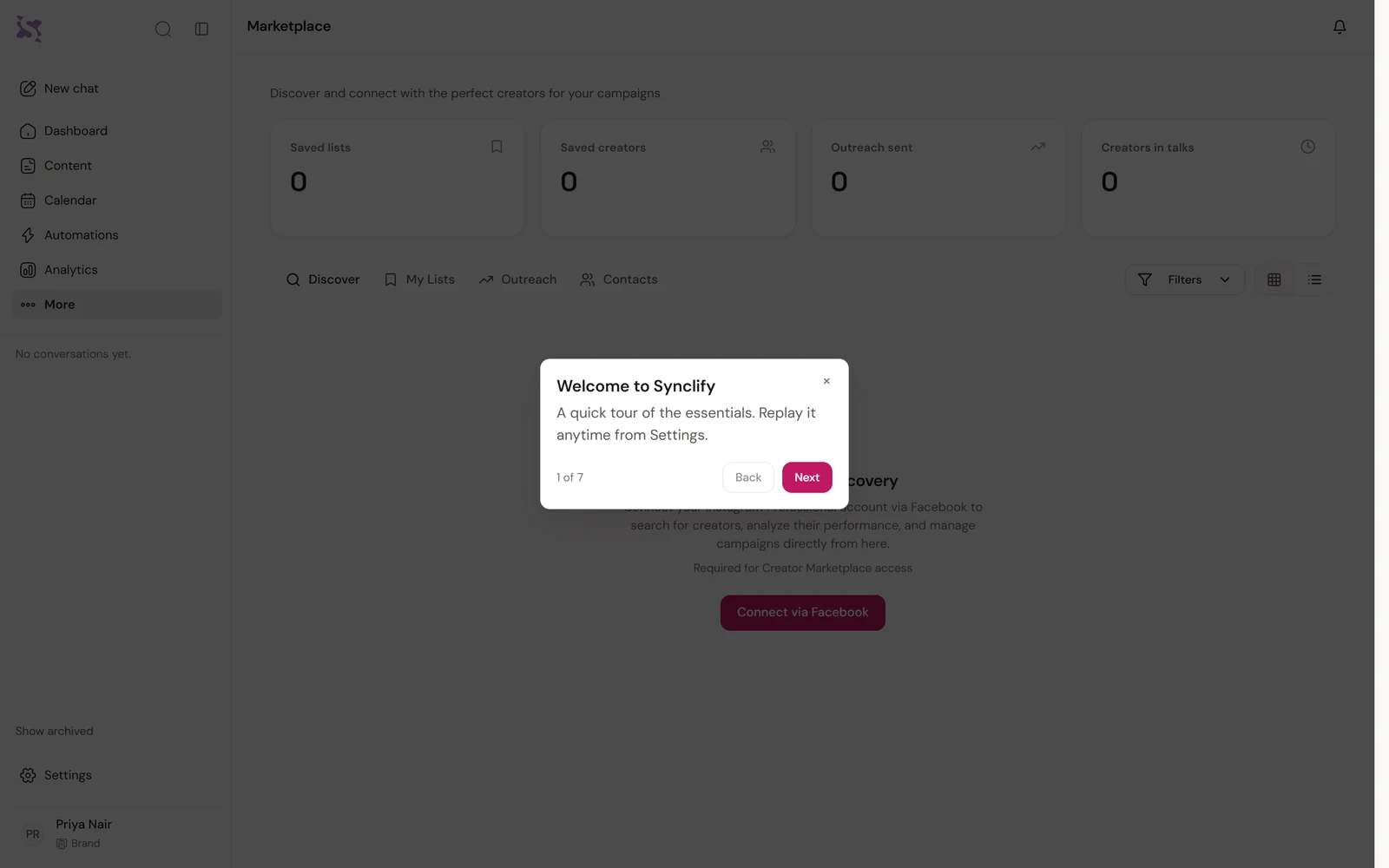
Synclify's brand side does two of the jobs in this article. The first is finding people. The search runs against Instagram's own creator marketplace and filters on who follows a creator rather than on what the creator writes about, so you can ask for creators whose audience is mostly women aged 25 to 34 in a named country. City and language are filters we add on top, because Instagram does not offer them, and a city means the place a creator names in their own bio, not where their audience lives.
How we know: creator search filters on audience gender, audience age band and audience countries, and reads a creator's city from their own bio. A test blocks a release if our age bands and Meta's disagree in either direction.
The second is the read. Ask about a handle and what comes back is Meta's own count of accounts that engaged over the follower count, expressed as a band rather than a score out of a hundred, with the limit written into the answer instead of a footnote: large accounts read lower than small ones for honest reasons, and the figure is a signal about whether an audience is real rather than a verdict on it.
How we know: a creator check returns the share of the audience that engages as a band, and the note under it on screen says it is a signal and not a score.
Two things it refuses to do matter more than the two it does. With nothing stored on a handle it first looks the account up in Instagram's own creator marketplace and reads it from there. When that lookup comes back empty it will not produce a reading at all, because vetting on no data is guessing dressed up as analysis. Instead it offers to track the account and watch how the following grows over the following days, on the reasoning that a bought following shows in the shape of a curve rather than in any single day's numbers.
How we know: with no saved profile, a creator check first looks the handle up in Instagram's creator marketplace. Only when that finds nothing does it return no score and offer tracking instead.
Questions brands actually ask
What engagement rate should I ask for?
Ask for a band rather than a number, and set it by size. Smaller accounts sit higher and larger ones sit lower, and any single threshold you pick will reject good creators at one end and pass weak ones at the other. If somebody hands you one figure to apply across every size of account, they have not measured anything.
Can a tool tell me whether someone bought followers?
No, and be careful with any product that says otherwise. Public numbers can show that an account looks real: engagement in the expected range for its size, comments that read like people, a follower curve without steps in it. Establishing what somebody purchased would need data that only Instagram holds, and Instagram does not hand it to vendors.
Is a small creator with high engagement always the better buy?
Not automatically. Small numbers move more, so one good post can lift a small account's rate for a month. Ask for reach on the last five posts, since reach is the number that translates into people seeing your product, and a high rate on a small base can still be fewer people than a lower rate on a larger one.
How much vetting is enough?
Match it to the cheque and to the category. A gifted product warrants ten minutes of reading. A year of ambassadorship in a regulated category warrants an afternoon, a conversation, and terms that let you end it early. The mistake is running the same twenty minute check on both.
- Emarketer, US influencer marketing spending will surpass $10 billion in 2025, March 2025 $10.52bn forecast for 2025, 15.0% growth against 23.7% in 2024
- Socialinsider, Instagram benchmarks, 2025 data median Instagram engagement rate 0.48%, from 35 million posts across 4,47,613 accounts, January to December 2025
- Meta Newsroom, Making it Easier for Brands and Creators to Collaborate on Instagram, February 2024 brands filter on creator and audience attributes; creators opt in from the professional dashboard
- Meta for Developers, Instagram Platform insights documentation insights returned only for professional accounts an app is authorised for; user metrics stored up to 90 days
- Federal Trade Commission, updated advertising guides to combat deceptive reviews and endorsements, June 2023 the revised Endorsement Guides took effect 26 July 2023; advertisers are expected to monitor their endorsers
How we checked this
- The filters the product's creator search offers, and the test that guards them.
- What a creator check returns, as it appears on screen.
- How a creator check looks a handle up when nothing is saved.



You have read how it works. Now watch it read yours.
Connect your Instagram and ask it one question. It reads the account first, so the first answer is about your posts rather than about Instagram in general.
Cancel any time. Every dashboard and report is free to open.