The journalTools
An agency morning across ten accounts
Managing other people's accounts is a routing problem before it is a work problem. Here is one morning, six to noon, and what each part of it actually costs.

In this piece
- 01 Nobody tells you which client needs you today
- 02 Writing in seven voices before lunch
- 03 Count your own morning
- 04 Approvals are where the work stops
- 05 One person off, and the week has a hole in it
- 06 The invoice nobody chased is the quietest loss
- 07 What a queue changes, and what it does not
- 08 Questions agencies ask about this
The hardest ten minutes of an agency morning are the ones before any work starts. Ten accounts, and nothing on any screen that tells you which of them needs you today.
Running your own account is a volume problem. Running other people's is a routing problem. The work itself is ordinary, and it arrives pre-split across ten inboxes, ten calendars, ten sets of numbers and ten people with opinions, none of it joined up. Almost nothing in the day is difficult. Working out what to do next is close to the whole job.
What follows is one morning, six to noon, at a small agency with a team of four. The clock is there because the costs land in an order, and the order is the point. The general version comes after.
- 6:40amChecking, which is not working
- 8:10amThree captions, three voices
- 10:00amFinished, and waiting on somebody
- 11:15amEleven things due, two owned by nobody
The morning below, in order. The marked hour is the only one where the cost is somebody else's to release.
Nobody tells you which client needs you today
6:40am, and you are not working yet. You are checking. Checking is a separate activity from working, it produces nothing anybody can see, and it takes about as long.
It also has a fixed route, and everybody who does this has more or less the same one. Open Instagram, switch account, look at the date of the last post. Switch again. Open the shared calendar to see what is booked this week. Open the inbox to see who wrote overnight. Open WhatsApp, because two clients prefer to talk there and one of them sends briefs as voice notes. Open the spreadsheet with the deliverables in it, which is the only place a due date is actually written down.
Forty minutes later you have been through everything and learned three things. Two of them could have been handed to you.
| What went wrong | Where you would find it | Before you notice |
|---|---|---|
| A client stopped posting | Their account, if you happen to switch to it | One to three weeks |
| An invoice went past due | The accounting tool, or nobody's screen | When you do the month |
| A contract is running out | The folder the PDF was saved in | When the client mentions it |
| Something is due today and nothing is drafted | The deliverables spreadsheet | The morning it is due |
| Comments on a post turned nasty | The client's own notifications | When the client forwards it |
| A post did far worse than that client's normal | The monthly report | Three weeks later |
Six signals, six homes, and not one of them opens itself.
Read the third column on its own. Every one of these is knowable on the day it happens. Almost none of them are known on the day they happen. Closing that gap is a large part of what an agency is paid for, and today it is closed by a person remembering to look.
Writing in seven voices before lunch
8:10am. Three captions, three clients. One of them writes in lower case and has never used an exclamation mark. One says customers and never says clients, and has said so twice. One will not use the word journey, for a reason nobody at the agency can now remember and everybody respects.
Holding somebody else's voice takes a run-up. You reread their last few posts, you get the rhythm back, and then you can write in it. For one client that is a warm-up. For seven in a morning the warm-up is most of the morning.
Microsoft published those in June 2025, in a Work Trend Index report called Breaking down the infinite workday, measured from its own aggregated Microsoft 365 activity data. Nothing in it is about social agencies. It is worth carrying anyway, because agency interruptions arrive from ten directions at once and each one drags a different client in with it. Every return to the desk hands you a different company's tone of voice to pick back up.
Count your own morning
General figures about other people's time are worth nothing. Yours are worth something. The rows below describe one account manager holding a handful of clients, over a week. Change the minutes until it looks like your week, including the rows where we have guessed high.
- Checking every client account for anything wrong150m
- Writing and editing in each client's voice240m
- Chasing approvals and re-sending edits165m
- Client calls, status messages and WhatsApp130m
- Pulling numbers together for reports150m
- Invoicing, and chasing what is late60m
- Planning the week across every account90m
854 hours a year, at this pace. Move the numbers until the week looks like yours.
arithmetic: the sum of your rows, times 52
Two rows tend to surprise people. Chasing approvals is one, because it never feels like work and has never appeared on anybody's timesheet. Checking is the other. It is the first thing every morning, it is invisible to the client, and across a month it is roughly a full working day spent finding out whether anything is wrong.

Approvals are where the work stops
10:00am. Thursday's carousel is finished. It goes out on Thursday if the client looks at it, and the client last looked at something nine days ago, on a Tuesday.
This is the bottleneck that never appears in a plan, because plans are written in production days. The draft took ninety minutes. The wait took six days, and inside those six days you sent two reminders, one of which crossed with an approval nobody thought to tell you about, so you also spent twenty minutes establishing whether the thing was already live.
- Give the client one place to look. Approvals sent as email attachments become an inbox problem, and their inbox is a queue they already lost control of. One link, one list, everything waiting for them, newest at the top. If a client has to search for the thing you need signed, the delay is yours.
- Put the deadline in the brief, not in the reminder. A date agreed at the start is a fact both of you accepted. The same date introduced in a chasing message is a request, and it reads as pressure however politely it is written. Say when you need sign-off at the moment you agree the work.
- Agree in writing what silence means. Some agencies publish on the scheduled day unless somebody objects, and say so before the first post goes out. Some hold everything until a human says yes. Either is defensible. Never having decided is the one that produces the argument.
One person off, and the week has a hole in it
11:15am. Take Fieldnote, the agency in our own demo world: seven clients and four people, which is a smaller roster than the ten in the title and behaves identically. Today it has eleven things due and two of them belong to nobody.
Eleven is the number an agency owner asks for. Two is the number worth knowing. Four people's calendars make a project management view and every team already has one. Work that nobody has picked up is what actually goes missing, and it goes missing on exactly the morning somebody wakes up ill.
What breaks when a person is off is rarely the task. It is what they knew.
- That this client's founder approves and the marketing manager does not, whatever the org chart says.
- That invoices for that one go to the accounts address, and anything sent to the founder sits unread for a month.
- That they will not use the word journey.
- That last quarter's report was written in reach, so this quarter's has to be written in reach, whether or not anyone now prefers views.
None of it is written down, because writing it down was never anybody's job. The fix is dull and it works. Every client gets one page answering those four kinds of question, and the page is updated on the day somebody learns something new. It costs ten minutes per client to start. It is the difference between a colleague being away and a client noticing they are away.
The invoice nobody chased is the quietest loss
Noon. Fieldnote's attention list has three things on it. Roam Coffee has had no content in the last fourteen days. Nine Yards has a contract that ends in eleven days. Amber Home's invoice is nineteen days late.
The first two are the ones an agency talks about in a meeting. The third is the one that costs cash, and it costs cash precisely because it is the easiest to postpone. Chasing feels rude. The client is nice. You will do it on Friday, and on Friday there is a shoot.
Those are from Intuit QuickBooks's 2026 Small Business Late Payments Report, which surveyed 1,305 US business owners in December 2025. It says nothing about social agencies specifically. The failure it describes is the recognisable one: somebody meaning to chase, on a day with other things in it.
The version that works leaves almost nothing to willpower. An invoice going properly late is flagged without anybody having to remember it, the reminder is drafted in your own words the moment you ask for it, and the only human acts left are asking, reading it and pressing send. Every step you leave to memory is a step that eventually gets skipped in a busy week, and busy weeks are the ones with the most invoices in them.
What a queue changes, and what it does not
This is the section about our product. It is one section rather than the whole article because everything above works whether or not you ever open it, and the two dull fixes in it, one page per client and a written rule about silence, cost nothing and are worth more than most software.
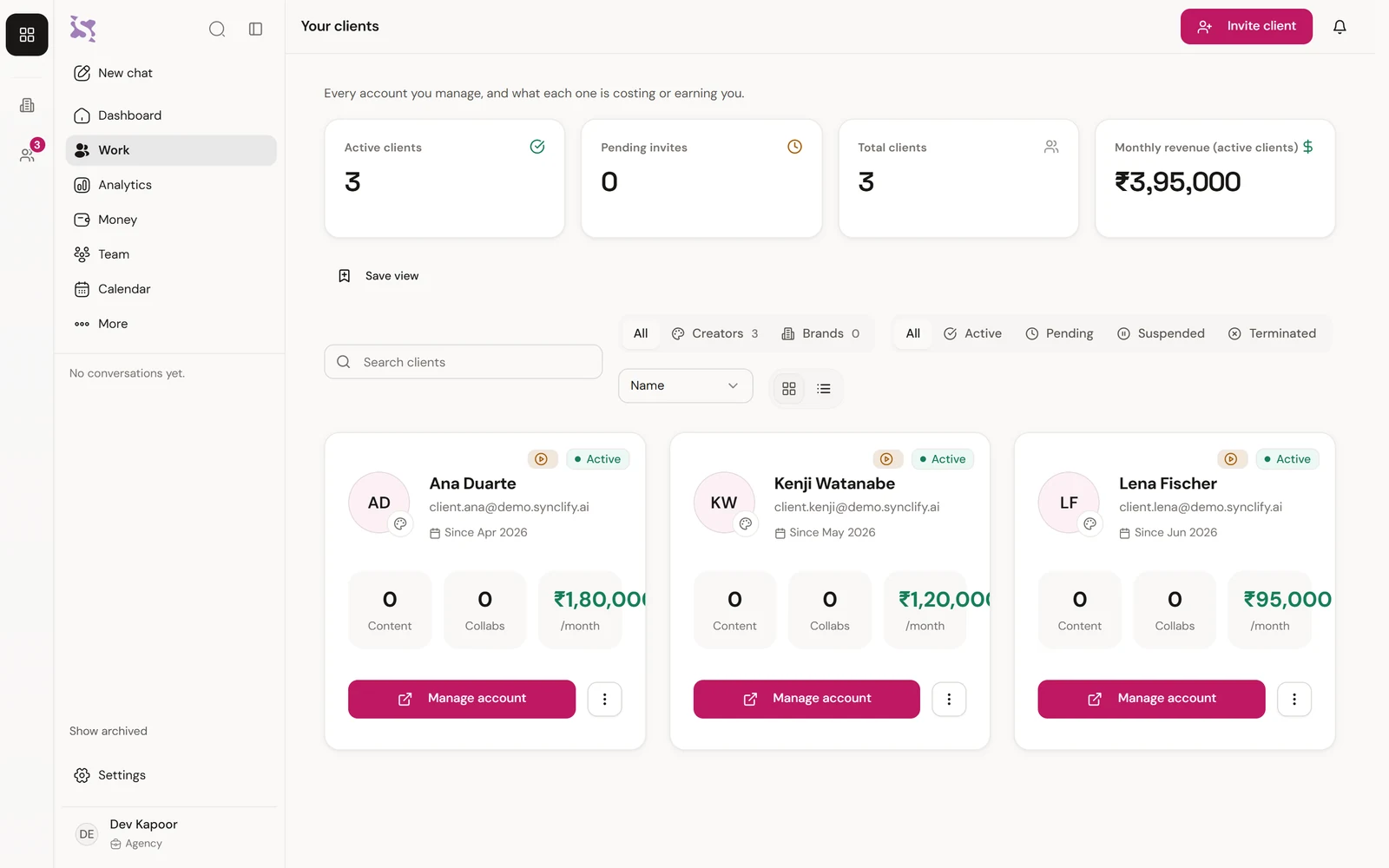
Synclify holds each client as its own workspace, so a thread about Roam Coffee is scoped to Roam Coffee: every lookup and every permission check binds to that one client, and the answer says which client it ran in. Team members are invited with the permissions they should have. What narrows for them is what each screen contains rather than which screens exist, because hiding the door as well as the room is how people end up believing a feature was never built. When somebody reaches something they are not allowed to see, it names the permission and offers to ask the owner for it.
Content goes out for approval and comes back approved or rejected on the content record itself, so the state of a draft is a property of the draft rather than a thing you reconstruct from an email chain. You can ask across the whole roster in one question, which is the part that replaces the 6:40am route: which clients have gone quiet, which contracts are running out, what is due today and who has it.
How we know: every client is kept separate, and every lookup and permission check is tied to one client at a time.
It also speaks first, on a deliberately short list of 32 subjects. The five you meet most: an invoice that is properly late rather than merely due, a post running away from that account's own baseline, comments turning negative, a deadline arriving with nothing to publish, and something due today. Anything wider than that trains a team to ignore the notifications, and then they miss the three that mattered.
How we know: a message it sends without being asked passes four checks first: messages switched on, not your quiet hours in your local time, the same subject not raised in the last 72 hours, and under the daily limit.
Nothing that another human being will experience happens without somebody agreeing to it first. Sending an invoice, publishing, replying to a comment on a client's account and putting a task on a colleague's plate all show you exactly what they are about to do and then wait.
How we know: assigning work to a person always waits for your tap, because a person is on the other end of it.
Questions agencies ask about this
How many clients can one person actually hold?
It depends far less on the number than on how many different shapes they are. Five clients who all post three times a week with one approver each is a comfortable load. Three clients where one needs daily stories, one has a committee, and one pays late every month is not. Count approvers and deadlines rather than logos.
Should we ask clients for their login, or get access properly?
Get access properly, through the client's own business account, every time. Sharing a password means offboarding is a password change and a fight, and it means the client cannot see what you did on their behalf. It is slower to set up once and it is the only version that survives a client leaving.
Is a white-labelled report worth the effort?
It is worth it when the report is going in front of somebody who did not hire you, a founder or a board, because your logo on their internal document is a distraction. For a weekly note to the person you talk to daily, a plain summary they can read on a phone beats a designed PDF nobody opens.
If we can only fix one thing this month, what should it be?
The checking. It is the first thing every morning, it is invisible to clients, and it is the only row on the tally above that produces nothing at all. Everything else on the list is work somebody is paying for.
- Microsoft WorkLab, Breaking down the infinite workday, Work Trend Index special report, 17 June 2025 Employees interrupted every two minutes during core work hours, 275 times a day, from aggregated Microsoft 365 signals
- Intuit QuickBooks, Small Business Late Payments Report, 2026 59% of surveyed US small businesses carrying invoices at least 30 days overdue, about $17,700 outstanding on average; survey of 1,305 US business owners, December 2025
- Meta for Developers, Instagram Platform: Insights, 2026 User metrics data is stored for up to 90 days
How we checked this
- The part of the product that keeps each client's data and permissions separate.
- The checks the product runs before it sends a message nobody asked for.
- The list of actions that wait for approval, which includes assigning work to a person.



You have read how it works. Now watch it read yours.
Connect your Instagram and ask it one question. It reads the account first, so the first answer is about your posts rather than about Instagram in general.
Cancel any time. Every dashboard and report is free to open.